
The Fifth Cup
A Guest at the Seder: personal history (non-fiction, not creative)

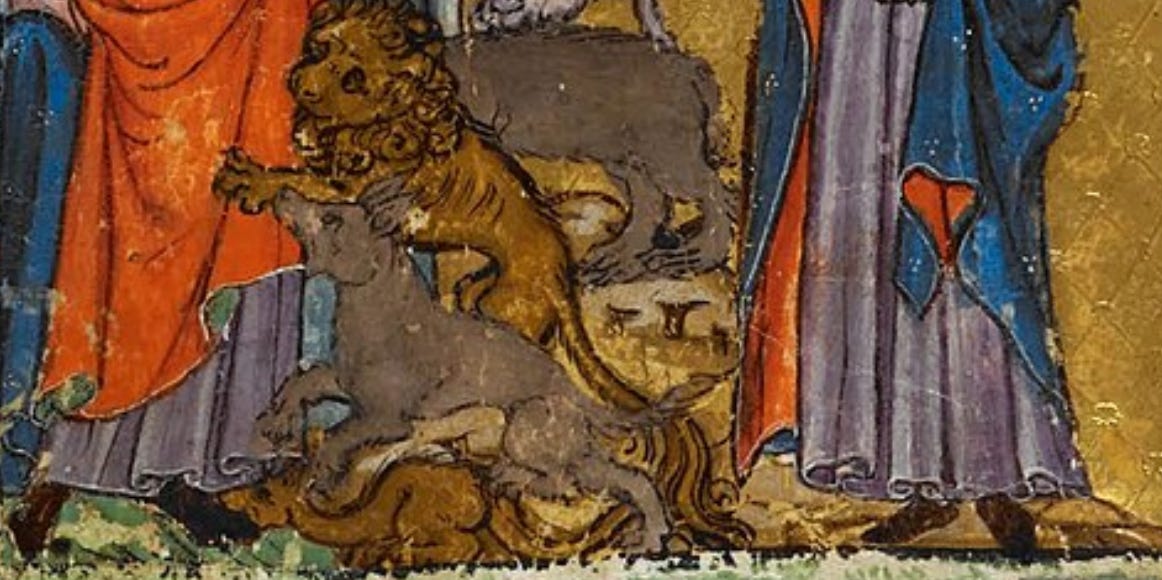
From the Golden Haggadah, circa 1320
The ceiling of my church’s parish hall is a vast, empty space. Sound rises and showers back down again like rain on a metal roof. Hearing aids crackle with interference. It is well known, nothing important should be said there without a microphone, and even then, most of the message will be lost somewhere between the parquet flooring and the rafters.
The night of the Seder, a dozen or so tables were prepared in the parish hall with eight place settings each. My mother sat to my left, my daughter to my right. I didn’t have any expectation that I would be able to hear the other people at our table; we just smiled and mouthed silent pleasantries. But I was looking forward to the evening. I made sure to RSVP for all three of us. I didn’t register my husband because I knew he would be asked to work that night. He was the Director of Children and Family Ministries and so, naturally, he would be pulled in to serve tables at an event with no children.
“Isn’t Passover next Thursday?” my daughter asked, directly into my ear.
“That’s right. Holy Week and Passover overlap this year.”
“They don’t always overlap?”
“No. We’re on different calendars. It’s different every year.”
“Why aren’t we doing this on actual Passover, then?” she asked.
“The rabbi will probably be busy with his own congregation that night.”
The chair to my daughter’s right was tipped forward, waiting for someone. For a fleeting moment I wondered for who.
“Does it count if we do this on the wrong night?” she asked.
“I don’t know,” I said. “I don’t know what it means ‘to count’. I don’t really know how it works. That’s why we’re here.”
Just before the rabbi opened up the evening in prayer, my husband brought Ethan* over to our table. I understood then that the chair had been reserved for him. My husband would be serving another table but he made sure to introduce us to Ethan and saw that he was settled before running off to the kitchen. I smiled and tried to welcome him even though I knew he couldn’t hear anything I was saying over the ambient chatter.
The rabbi lit a candle at a podium in the front of the room. He gestured to the upholstered chair to his left. That was Elijah’s chair, clearly borrowed from the luxuriously decorated sitting room adjacent to the parish hall. He went on to explain that, during a typical Seder, a child would be asked to open the door for Elijah at the end of the evening, but that since there were no children here tonight, we would skip that part. I exchanged a glance with my daughter. At thirteen, she seemed satisfied with not being identified as the only child present. I wondered if she were also wondering if, by skipping the ritual at the door, the Seder would still ‘count.’
In the center of each table sat a plastic plate with the symbolic foods labeled in Hebrew. Perhaps the church had borrowed them from the synagogue, just as they had borrowed the set of Haggadah, with worn edges and lovely watercolor illustrations. We soon began, the rabbi’s words muffled by the echo of his own voice raining back down from the high ceiling, guiding us through the story of Exodus. I settled into my chair. It is a long story. But a familiar one. Most Christians I know are familiar with the story of Moses. We spend a lot of time in Sunday School and Vacation Bible School talking about Moses and Pharoah. The plagues are too horrifically vivid to ever forget. We know about Moses; it is Elijah who is the stranger.
I tried to make sure my mother was on the right page of the Haggadah, which she found confusing as the books are bound from right to left. My daughter flipped through the illustrations. She nudged me with a furrowed brow, pointing at a lion. We quietly counted the plagues on our fingers - the blood, the frogs, the gnats, the dead cows, the boils, the hail, the locust, the darkness. The Angel of Death. Neither of us remembered any lion. What were we missing? Unable to sit with the unknown, I discreetly pulled out my phone to look it up.
We had forgotten the flies, the fourth plague, which apparently are the cause of an ongoing rabbinical debate. Question remains over translation of the word arov ( עָרֹב). God sent a mixture, but of what? Swarms of biting insects or herds of wild beasts, such as lions? Fifteenth century Rabbi Yehudah argued that it must have been a variety of wild beasts sent to terrorize the Egyptians, as the Egyptians had once used wild beasts to terrorize the Hebrews. And the Midrash presents the case that if the frogs of the second plague were left to rot and stink as additional punishment, then why would the arov be removed from Egypt once the plague had ended? Mountains of dead flies would only amplify the effect of the plague. Mountains of dead beasts would have been valuable, for leather or furs, and so they were removed. The Egyptians could not be allowed to benefit from the plague sent to punish them.
And the Lord did as Moses asked, and removed the swarms of [arov] from Pharaoh, from his servants, and from his people; not one remained. Exodus 8:31
My daughter interrupted with a whisper,
“Mom, is there going to be any real food tonight? I’m hungry…”
“Shh. I’m hungry too. I’m sure there will be more food later.”
Ethan was also looking forlornly at the center plate. Just one plate for all eight people at the table. One shankbone, one egg, one basket of matzah. Our server, a vestry member, came over with two small carafes of wine, one white and one red. I couldn’t help but notice that the table next to ours had four entire bottles all to themselves. It didn’t seem fair. I knew enough to know that we would each need four glasses of wine before the night was over. We passed the carafe of white, each pouring only a splash, and even with my daughter abstaining, it didn’t make it around the table before running out.
“Mom, I’m hungry…” she hissed.
I pushed the basket of matzah towards her and told her to try it. It was likely the only thing on the table she would eat. She took a few pieces and then passed the basket around. The rabbi continued his instructions, telling us the meaning behind each of the symbolic foods. Some of us reached forward to take a leaf of parsley, or a sweet crumb of charoset. Ethan leaned over and whispered to me,
“I don’t really know what’s going on.”
“It’s ok,” I said. “If we didn’t have this prayer book I wouldn’t know either. I can’t hear what the rabbi is saying.”
“No, I mean, I don’t know what any of this is about.”
I paused, considering how I might explain this to a stranger.
“This is a Seder dinner,” I started. “Or, the rabbi is teaching us about the Seder dinner. It’s Passover, or rather, Passover is next week. It’s - it’s a special dinner - it’s when the Jewish people remember how they were freed from Egypt. The story of Moses and the Pharaoh. A long time ago…”
Ethan nodded slightly. He was very polite. And also curious and confused.
“But isn’t this a Christian church?”
I could only explain it as I understood it. I reached far back into my memory of First Communion classes, when the line between the Passover and the Eucharist was first drawn for me as a little girl.
“We’re here to learn more about the Seder because Jesus was Jewish and the Last Supper, his last meal with his disciples, his friends, was a Passover meal. That’s why Communion wafers are so thin - they’re unleavened bread, just like these crackers here, like matzah. Because once Pharoah said the Hebrews could leave, they had to leave quickly, before he changed his mind again. They didn’t have time to let the bread rise. And so, that’s why the bread we use for the Eucharist must be unleavened bread. Because the Eucharist is our Passover meal…”
Ethan nodded his head and smiled. I couldn’t tell if he could hear me or follow my disjointed explanation. I didn’t know what kind of religious background Ethan had. The room was too loud to ask. I didn’t know if he even knew what the Eucharist was, or if he had ever received it in an Episcopal church, or if he’d received it in other ways, with fluffy homemade bread, or Wonder Bread™ or some other kind of bread I was raised to believe doesn’t really ‘count’. Ethan might not even know what Communion wafers are or have any interest in why they melt in your mouth.
Therefore let us keep the feast, not with old leaven, neither with the leaven of malice and wickedness; but with the unleavened bread of sincerity and truth. 1 Corinthians 5:8
The Eucharist is our Passover. I stopped my explanation there. But certainly, it was not enough to make any sense to our guest. I understand why the idea of a “Christian Seder” is controversial and even offensive to many Jews. I took comfort in knowing that what we were doing was not really a Christian Seder. The rabbi of the largest synagogue in our city had a friendly relationship with our priest and congregation. They participated in ecumenical activities together and seemed to hold each other with mutual respect. The Seder that night was not going to be recontextualized by our priest, who sat at a table with the rabbi’s family, who were likely the only Jewish people present. The rabbi and his son, the evening’s cantor, were the only ones to lead us in prayer. We were there in the spirit of education, but whatever understanding of the Seder we would take away as Christians, we would have to glean ourselves, with whatever knowledge we came in with.
As a Christian, I believe that the Passover is essential to understanding our own rituals. Even as a young girl, I believed I understood the metaphor. God told the Hebrews to paint their doorways with the blood of a lamb, to protect their households against the Angel of Death. Christ is our Paschal lamb and his blood is painted over the doorways to our hearts. The bread and the wine are symbols of the flesh and blood of Christ. They are symbols and they are also real. Jesus is the lamb, and he is also the bread and wine with which we remember the flesh and blood of the lamb. His flesh is lamb and it’s also matzah. His blood is Port. He is our Passover meal, sacrificed for us. But how can we understand any of that, if we don’t understand the Seder?
The rabbi turned our attention to the matzah. He told us to break a piece and to take the larger portion and wrap it in a napkin, setting it aside for later. He explained the role of the afikoman, telling us that typically this set aside matzah would be hidden for the children to find later, but as there were no children at this Seder, we would not hide it. I looked into the basket on our table and found that my daughter had already eaten all of it. I frowned and told her to apologize to everyone. We were all hungry and she had been greedy. Would it still count if we didn’t have enough matzah to complete the ritual? I got up to ask for another basket for the table but was told there weren’t any more boxes of matzah in the kitchen.
“Is anyone going to eat that?” Ethan asked, pointing to the shank bone. He was sure to gather everyone’s bewildered consent before picking it off the center plate. Does one eat the shank bone at a Seder? I tucked the question away for later. It seems that the answer is no, most people do not eat the zeroa. The shank bone is meant to symbolize the Paschal sacrifice. But it cannot actually be the sacrifice as Jewish law prohibits sacrifices made outside of the Temple and the Temple was destroyed a long time ago. Ethan couldn’t know this as he picked the bone clean. Next, he asked if anyone wanted the hardboiled egg, and once everyone at the table confirmed that he was welcomed to it, it disappeared into his mouth in a single gulp.
I realized then that Ethan was hungry. Not the way my daughter was hungry. Not the way anyone else at the table might have understood what it means to be hungry.
Ethan lives at the Marshall House, a dilapidated three story Victorian that sits behind the church’s old book store. He is perhaps the only person who actually lives on church grounds. He sleeps on the porch, or perhaps under the porch. The house has had various lives, most recently as a women’s shelter, which was later moved to a nicer, less rat-infested building. The house had been vacant for many years by the time Ethan found it a safe enough place to sleep.
My husband befriended Ethan over the course of his time working for the church. He often saw Ethan in the corner of the parking lot when he took bags of church-trash out to the dumpster behind the vacant book store. He found Ethan to be friendly and polite. He determined that Ethan was a decent neighbor whose presence actually protected the house from less friendly and less polite actors. He listened to Ethan’s stories and sometimes brought him food from the church’s café. The day a colleague called the police on Ethan for trespassing on church property, my husband came home in a fog of disillusionment. He was able to negotiate on Ethan’s behalf and the policeman eventually left him alone. But it was an early fissure in my husband’s work life.
The day of the Seder, my husband made a point to invite Ethan to eat with us. He sat Ethan with his own family because he could trust us to make Ethan feel welcome. If only I could assure Ethan that eventually, the symbolic food would make way for something more filling.
What does one eat at a Seder? After the bitter herbs and the matzah, after all the prayers and plagues and the first two cups of wine, what does one eat? Like the fourth plague, it seems up for debate. Ashkenazi Jews intentionally avoid serving lamb, for much the same reason they do not eat the zeroa. Like a geometry proof: the Paschal sacrifice was originally a lamb, the Paschal sacrifice can only be made at the Temple, the Temple is no longer standing, there can no longer be a true Paschal sacrifice and so there is no lamb served at the Seder. Sephardic Jews, on the other hand, may eat lamb at Passover, as long as it is not roasted. They do this in remembrance of the ancient Paschal sacrifice, knowing that the true sacrifice can only be remembered, never eaten.
When finally, the symbolic feast gave way to the festive supper, we each received half a roasted chicken with potatoes au gratin and a salad. I gave a sigh of relief and looked at both Ethan and my daughter with eyes that tried to say, “See? I told you there would be food!”
Busy silence descended upon the parish hall as everyone got to work on their chicken. It was delicious. The church has a very talented chef on staff. She runs the church’s lunchtime café during the week. Downtown professionals often come in for lunch meetings over pulled pork sandwiches and the best potato salad they have ever tasted. Residents of downtown parks and cardboard boxes come in too, to use the bathroom and ask for free coffee. My husband was sometimes called downstairs to shepherd them out without disturbing the paying clientele or ruffling any feathers. He was well known for his deescalation skills. The chef often prepared a brown bag of snacks to hand off as he guided someone towards the sidewalk.
Ethan deboned his chicken expertly, with the skill that only hunger can teach. And quickly, as if it might disappear from his plate at any moment. I looked down at my own meal and suddenly didn’t want it anymore. And then I felt anguish that it would go to waste while the man sitting next to my daughter was so hungry he was sucking the marrow out of the tiniest of chicken bones. But neither did I want to insult him by offering him my leftovers. I didn’t know him intimately enough for that.
I got up and looked for my husband. He was busy, serving other tables, running chickens from the kitchen. But he soon brought another plate for Ethan, as well as another slice of flourless chocolate cake for both Ethan and my daughter. They each agreed the cake was delicious. I found it very rich; I would have to take it home with me and eat it later.
Ethan ate three chickens that night, including my own, as I correctly concluded he probably wouldn’t be insulted at all. However much chicken he ate tonight, it would never be enough. He was eating for all the hunger of yesterday, all the future hunger of tomorrow.
Were we doing this right? If you can’t have roasted lamb, is roasted chicken kosher? Did we eat enough matzah to make it count? Enough bitterness, enough sweet? Was it possible the rituals left undone - opening the door for Elijah, hiding the afikoman - made the Seder any less real? Our vestry member was neglecting our table. The rabbi raised his glass for the third toast but my table was dry. I got up again, looking for someone to serve us more wine. My husband was busy. By the time someone came around to top us all off, the moment had passed. I couldn’t hear what the third toast had been about but we missed it.
At the beginning of the night, the rabbi had explained that the Seder moves us from bondage to liberation. Over the course of the night, stepping through the story of Exodus with each prayer, each bite, each glass, we were traveling towards freedom. But freedom from what? So many thousands of years removed from the flight from Egypt, with so many other yokes of oppression found in the present, does Pharaoh stand in for every dictator? Is Egypt every empire? Is Moses every freedom fighter?
Or is the bondage even further abstracted? I looked over at Ethan and wondered what it was that bound him to his life of poverty. It didn’t even occur to me then to wonder what bindings entrapped my own family.
The rabbi explained that the four glasses of wine are intrinsically related to this movement towards freedom, each toast tied to an expression of redemption found in scripture. And our table had been forgotten. The dinner ended and the final prayers spoken before anyone came back with our fourth round.
One month after the Seder, my husband was fired from the church. He had lost control over his sobriety and had begun drinking in his office. He was given a disciplinary letter that seemed to offer a path forward, but the next day they found beer cans hidden away in a closet and for whatever reason, that was a step too far for redemption and he was terminated a day later.
I thought there couldn’t be anything more wholesome than making church the center of my family’s life. It was me who showed my husband the job opening and encouraged him to apply. Director of Children and Family Ministries. There we would be, all in one place, my daughter an acolyte, my son in the Festal Eucharist class, my husband leading Sunday School and Youth Group and staffing the nursery for funerals and weddings and baroque concerts. From cradle to grave, there wasn’t an event he was exempt from. It exhausted him. But I was very proud of him. Every time someone came up to me, to tell me about the good job he was doing, I took pride in it.
When he received the disciplinary letter, I immediately asked for a meeting with our priest, thinking I might be able to salvage this. I planned to tell him my husband’s story. To make sure it was understood how overworked he was, how little he was sleeping. To explain that we had already made a mental health appointment for May 15, over a month ago. It just took that long to get treatment in our city.
I listened first, knowing that I might not have the complete picture. While I was at the church several times a week, I didn’t work there. I knew there were things I could not know. I asked, because I wanted to be sure, if my husband had ever endangered anyone, ever harmed or threatened anyone, any of those ugly things that so often go hand in hand with alcoholism. Was he accused of anything beyond intoxication on the job? I was told no.
Surely then, my priest would understand that, in the midst of a severe mental health crisis, what my husband needed was medical leave, not termination. How could losing his income, his health insurance, his church community all at once help him? But very quickly, I saw a vacancy behind my priest’s eyes. He had already disconnected from this story. Whatever affection or respect he had once had for my husband was gone. He looked at me like a stranger.
“I don’t see God in this process,” I said at the end, trying very hard to keep my composure. “This is just about liability, isn’t it? I don’t see any grace in any of this.”
To which he replied,
“There are other ways to show grace.”
It was a revelation. A veil was pulled away. This was a man I had respected, whose sermons I followed closely, whose words affected me deeply. But it was all just words. Here was my spiritual leader, in a tradition centered around redemption, who had no interest in taking part in any redemption story. Sometimes, the contours of grace are defined by absence.
Two days later, I drove my husband to rehab. He wasn’t going to make it to the May 15 appointment at our local hospital. He needed treatment more immediately, so we drove three hours west to Navarre Beach. On that rainy drive, the memory of the Seder and all its persistent questions began to gnaw at me.
I had believed it was all real. I thought what we were doing was real and not play-acting. Our sacraments are visible, tangible, existing in this world. But our highly ritualized Eucharist is so far removed from the culture of animal sacrifice that we cannot even comprehend why the blood of a lamb would hold any power at all. Ancestors used to sacrifice a living, bleeding creature. And now we don’t even slaughter our own food. We don’t understand our own symbols; how can we understand the truth beneath them?
In our liturgy, lay people are allowed to read the first and second readings, from the Old and New Testaments. But only clergy read the Gospel out loud. The crucifer and torch bearers come down into the aisle, close to the congregation, so that the priest or deacon can read from the gilded Gospel by candlelight. They might raise their hands, as if calling upon the Holy Spirit to descend upon them, to speak through them. It is a ritual set apart. To say, these words are special even among other special words. It is one of my favorite parts of Mass. But lifting up the Word in this way isn’t the same as living the Word. When words of redemption and grace crash against our anxious, litiginous culture, the culture will always win. And then I have to ask, what are we doing?
And so we are cast out. I have to leave the church where I made my First Communion, my Confirmation, the church where we were married and baptized our children. Not because I am ashamed. Not because we were asked to leave. It’s because I can’t get past it. He was treated as expendable. He was used up and cast aside. Our priest left the entire graceless process to a newly ordained deacon. A former nurse who should have understood better than anyone that what she was observing wasn’t sin, it was a mental health crisis. My eight year old son asked if we were banished from church and I had to tell him no. The problem lies with me. It’s that I cannot sit in church angry. I can’t receive Communion with anger in my heart. And so we will have to find another place to worship.
He couldn’t call the first week at rehab. Early on, I felt resentful that he got to spend a whole month reflecting on his life while I had to keep going, feeding children, cleaning the house, explaining everything to our family. The only thing I got to do alone was cry. I imagined him sitting next to the water in a contemplative state, writing in a journal. But the first night he called, he told me a man in his cabin had died in his sleep just a few days before and the grim reality of this disease sank in. I wondered if my husband was so generous of himself with neighbors like Ethan because he knew the line between his life and theirs was so thin. The thinnest of places.
There is an Episcopal church in Nashville, where we used to live, that was razed by a tornado in 1998. While the church was rebuilt, part of the original foundation was left open and a labyrinth was painted over it. An inscription was engraved on the edge: God was not in the tornado but in our response. I’ve clung to that. If I were a person of weaker faith, it might have been shattered. But I do not see the hand of God in this botched HR process. In all of this spiritual devastation, God is found in the prayers, the meals, the kindnesses extended to us by friends, family, and neighbors. God is in the people, not the institution.
There has been kindness. There has also been silence. And inexactitude. Over time, I realized that many people in the congregation have been led to believe he is on medical leave. When will he be back, they ask. Perhaps it was a story invented with the intention of protecting him, but who does it serve to say he was given the very thing he was denied? There is no benefit to us in this dishonesty. To hide what happened would mean that we are ashamed. Maybe I am embarrassed that someone saw my husband at his worst. But I am not ashamed of him.
I’ve been ruminating the church’s corporate-sounding mission statement: Deep roots, true belonging, abundant grace. These words, as part of the church’s official letterhead, were printed on the disciplinary letter my husband received. Abundant grace, abundant grace, grace overflowing abundantly. Words that amount to no more than a shank bone. A symbol of something real, but completely meatless.
For we do not have a high priest who is unable to empathize with our weaknesses, but we have one who has been tempted in every way, just as we are—yet he did not sin. Let us then approach God’s throne of grace with confidence, so that we may receive mercy and find grace to help us in our time of need. Hebrews 4:15-16
I haven’t seen Ethan since the night of the Seder. I wonder how he is doing, now that the summer is here and it’s hot even at night. The Marshall House is scheduled to be torn down in the near future. While still elegant on the outside, the inside is reportedly full of asbestos and vermin. They say it is beyond repair. The empty space will become an extension of the parking lot. I wonder where he will go. He avoids the shelter and he has his reasons.
When the Seder was over, someone came around to collect all the copies of the Haggadah. My mother, daughter and I packed up to leave. My daughter had somehow acquired several extra slices of flourless chocolate cake and was determined to carry them home. But I was still worried about the wine. I scanned the room for someone who could provide me with the fourth and final glass. I was unsettled by the thought of leaving the ritual unfulfilled. I must have made a comment out loud because Ethan looked around the room too. And he noticed that the table next to ours had left an unfinished bottle behind. It was more than half full. He brought it back and proceeded to pour a fourth glass, first for me and then for himself.
In a horror film, when the director wants to imply madness, they might have a character pour a glass of wine until it overflows onto the table. If the wine is a very dark red, this can be foreshadowing of the blood that will spill or symbolic of the blood already spilt. Only someone who is mad would allow wine to overflow from the glass like that.
Ethan poured his glass out of a vertical bottle. The wine rushed up to the brim but did not overflow. The look on his face was not madness but rather, obligation. He hadn’t been raised to leave wine in the bottle. Neither had I.
“I know who you are,” I told him, now that it was quiet. “My husband talks about you sometimes. I’m glad you sat with us.”
“Your husband is a good person,” Ethan said.
“I know.”
When I was done, I put my glass down and gathered up the extra slices of cake. Ethan wasn’t taking home any leftovers. He didn’t have anywhere to put food or wine except his body. He knew he couldn’t take any of it with him and so he finished his fourth glass. And then he poured himself a fifth.
No comments section, but feel free to send me a message.
Heather